What do humans need to thrive?
What do humans need to thrive and how does the world today help or hinder us in meeting our needs? We all want to flourish but the realities of life make this hard. It makes sense that we can struggle when we understand all the needs we have and how they can come into conflict. It is difficult to satisfy them all, all the time, it is a juggling act with multiple balls. Models such as those by Maslow, Deci and Ryan and Ryff describe the following as universal needs. We might vary in how much we prioritise them, but the argument is that if we neglect them, they will have an impact on our wellbeing in the long term.
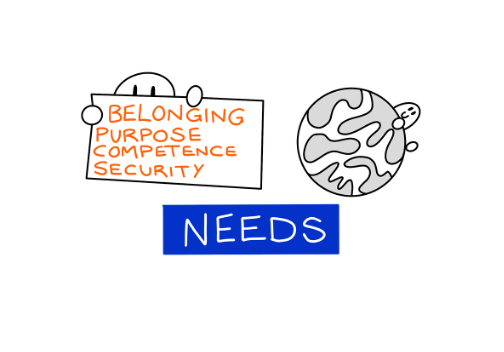
Basic survival - Food, water, a roof over your head
Health - Having physical and mental energy – influenced by sleep, daylight, exercise and movement, nutrients, managing stress levels
Safety and security - Feeling safe from physical and mental harms
Belonging - Feeling accepted by other people. Close and supportive relationships
Competence - Feeling effective and capable
Purpose and meaning - A reason to get out of bed, contributing to something outside of yourself, your ‘why’
Autonomy - Feeling of having control over your own actions and influence over your future
Pleasure - Activities that give you pleasure in the moment
Meeting the needs of one can come at the expense of another. Wanting to feel like you are doing a good job at work might mean working longer hours, which makes it harder to meet health and relationship needs, or have time for fun. I don’t have time to go to the doctors; I am sure it will be fine. I just need to finish this project then I can fit in some exercise.
We might work hard due to a fear of not having enough money and not being able to meet the survival needs or stay in a job that doesn’t give us a sense of meaning as it pays well.
Wanting to meet the competency need in all areas of life might lead to stress and impact health through lack of sleep for example.
The need to belong and be accepted could lead to engaging in behaviours that don’t help your health needs or align with your values. This is particularly noticeable in the teenage years when the need to belong and be accepted by peers is strongest. Research shows that the pain we experience from social rejection comes from the same part of the brain as when we have physical pain, so we will try to avoid it.
As life commitments increase, the fun element can get lost as well. Conversely overdoing things that give us instant pleasure such as social media scrolling can impact on our health and relationships.
As I shared in my previous article about the brain as a prediction machine, our beliefs about ourselves, others and the world will have an impact on the importance we place on each need. If you believe you are not good enough at work and will get found out, so must constantly prove your worth, you are more likely to prioritise the competence need. If you feel guilty about spending time doing things you enjoy you might deprioritise that over meeting the needs of others.
The social and work environment can help and hinder meeting our needs. Social media can help us connect and feel like we belong, but if overdone can lead to a disconnection from face-to-face relationships. Some jobs encourage a sedentary lifestyle, sitting inside at a desk all day with little movement or daylight, which negatively impacts the ability to meet health needs. Someone shared recently how little they moved in the day due to back-to-back online meetings, with their partner bringing them cups of tea so they didn’t need to leave their desk. Access to ultra processed foods that are convenient in a busy life are another factor. The paradox is we have better access to healthcare and knowledge about what helps us to be healthy, but the instant access to sources of pleasure makes it hard for our brains to resist. Working from home can help free up time to meet other needs but could be at the expense of feeling like you belong at work.
So how can we manage this?
Carry out an honest review of which needs you are meeting, which you are prioritising or neglecting and why
Self-compassion – it is impossible to meet all the needs all the time. It is about a balance over time and finding small ways to readdress the balance. By showing yourself compassion you can help reduce the guilt that is not accurate or helpful
Find ways to meet more than one need at a time. My friend is an avid park runner who is ticking off as many locations in a year as she can. By taking part with her friends and family, and setting herself goals, she is meeting connection, competence and health needs in one go
Are there any worries and fears that mean you prioritise one need over others that are not true or helpful? If you can find ways to manage these worries you might have less drive to prioritise that need
When you are juggling lots of things, think about which balls are made of glass and which are made of rubber. Bryan Dyson (former CEO of Coca Cola) famously made a speech where he urged listeners to imagine juggling five balls – work, family, health, friends and spirit. He stated that work is a rubber ball that if you drop it, it will bounce back. The others are glass balls, if you drop them enough, they will break. If you miss one meeting, nothing will happen. If you keep missing family events, eventually the relationships will break. If you keep neglecting your health, you will get ill. Protect the non-negotiables
Daily habits – what small behaviours can you weave into your day that don’t take much time but that can meet some of the needs? This might be messaging a friend to meet the connection need, doing a walking meeting to meet the health need or ten minutes of reading to meet the competence need
Being present – often it is not the fact that we are always at work but that we are not present with loved ones when we are not at work. It is possible to learn how to be more present and focus in the moment
Purpose and meaning – these are big topics that I will explore in more depth in future articles. One place to start exploring this is the Japanese concept of Ikigai ‘a reason for being.’ It is found at the intersection of what you love, what the world needs, what you are good at and what you can get paid for. Another Japanese philosophy is ikki nomei – finding one small reason to live. It is about finding a tiny tangible purpose to look forward to each day such as a morning coffee. For me it is walking my dog. It encourages a focus on the small joys of life.
What can organisations and leaders do to help meet these needs?
If people in a team are thriving and have their needs met, they are likely to be happier, healthier and perform better.
You can start by asking - what is it about our culture that helps or hinders people meeting these needs? What behaviours do we encourage, ignore and reinforce?
Health – how is the working day structured, and does it allow time for movement and exercise? Do people in senior positions role model prioritising health? Is there a culture of being present at a desk all day regardless of performance? Standing desks are an option to reduce constant sitting in one place.
Belonging – are there cliques and silos and how are these managed? Belonging is a feeling so how do you find out how people feel?
Competence – are people clear what is expected of them and what doing a good job looks like? Are they developed so they feel capable? In roles where there is not an immediate ability to know how you are doing, what can help people to see the impact they are having? Is there a feedback culture? You can also help people feel comfortable enough to share if they have worries about their performance and help them manage these (psychological safety)
Purpose and meaning – can you help people understand why the organisation and team exists, its vision and how their values and strengths support this?
Autonomy – Leaders who empower and give choice within constraints enable their teams to have a sense of autonomy, the opposite of this is micromanagement or doing it themselves
Fun – some of the best and highest performing teams I have been part of made sure fun and humour were encouraged
Models
Edward Deci and Richard Ryan – self-determination theory
Abraham Maslow – hierarchy of needs
Carol Ryff – six factor model of psychological wellbeing